Lucas D'Onofrio
Manager of Flood Underwriting
- Fort Lauderdale, FL

Flood risk is often misunderstood, including by property owners who live outside traditional high-risk zones. While coastal communities tend to dominate headlines after major storms, flooding is a nationwide issue that affects properties far beyond the shoreline.
According to Lucas D'Onofrio, ANFI, manager of Flood Underwriting at RPS, one of the most important statistics agents should remember is that roughly 30% of flood claims occur in Federal Emergency Management Agency (FEMA)-designated low-risk areas.
"Every property in the United States is in a flood zone," D'Onofrio says. "When people hear they're in an X zone, they think it means they're not at risk. What it really means is they're in a lower-risk zone, not a no-risk zone."
While flood exposure exists across the country, coastal properties face a different level of hazard due to storm surge, wave velocity and repeated water impacts. Understanding these differences and explaining them clearly to clients is becoming an increasingly important role for agents.
Flood zones established by FEMA categorize properties according to their relative flood exposure. High-risk areas are typically designated as A zones or V zones, while B, C and X zones represent moderate- to low-risk areas.
The problem, D'Onofrio says, is that many property owners misinterpret those classifications.
"As I mentioned, low risk doesn't mean no risk," he emphasizes. "It simply means the probability is lower compared to high-risk zones. But we still see a significant percentage of claims coming from those areas."
For agents, this misconception presents both a challenge and an opportunity. Clients purchasing homes or commercial buildings in so-called low-risk zones often decline flood coverage without fully understanding the potential exposure.
Advisors who clearly explain how flood zones work can help clients make more informed decisions about coverage.
While flooding can occur anywhere, the forces behind coastal flooding differ significantly from those affecting inland properties.
Inland flooding is typically driven by hydrostatic pressure, which occurs when standing or slowly rising water presses against a structure. This flooding is the type commonly seen after heavy rainfall, river overflow or storm runoff. Homes may sit in several feet of water for extended periods, placing sustained pressure on foundations and walls.
D'Onofrio explains that many inland homes are built on slab-on-grade or with crawl spaces, leaving the structure vulnerable to prolonged pressure.
Coastal properties, by contrast, must withstand hydrodynamic forces — water in motion.
"In coastal zones, you're dealing with high-velocity currents, wave action and storm surge," D'Onofrio says. "Those waves repeatedly strike the structure, and over time, that hammering effect can lead to structural failure."
This type of flooding is characteristic of V zones, where wave velocity and surge levels can cause severe damage during hurricanes and coastal storms.
Unlike inland flooding, which often develops gradually, coastal flooding can deliver intense force in a short period.
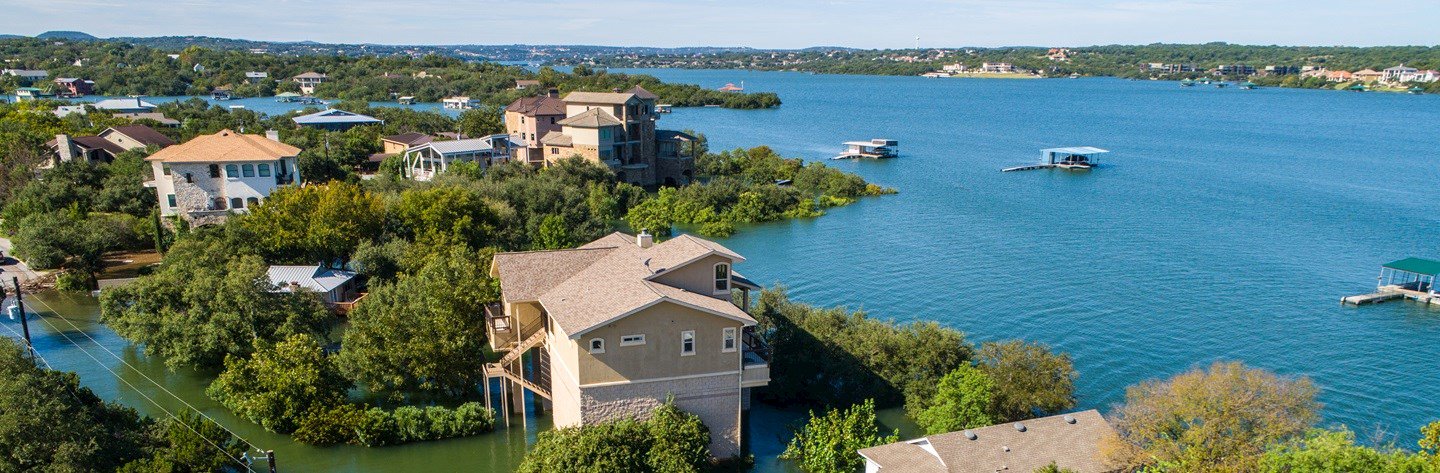
Because of the increased forces involved, coastal building codes are far more stringent than those in inland areas. Homes in high-risk coastal zones are typically required to be elevated on piles, piers or posts, allowing water to flow under the structure rather than pushing directly against it.
"The idea is to allow water to pass under the building," D'Onofrio explains. "If the structure sits directly on the ground in a coastal zone, it's far more vulnerable to damage."
Many coastal homes also incorporate breakaway walls on the lowest level. These walls are designed to collapse during severe flooding without compromising the structural integrity of the elevated living space above.
Often, the lowest level of these homes is used for parking or storage rather than primary living space.
Properties built before modern FEMA flood maps and building codes often lack these elevation features. While they may still qualify for flood insurance, premiums can be significantly higher.
"If a coastal home isn't elevated, premiums can easily double or triple," D'Onofrio says.
Additionally, for many coastal properties, the National Flood Insurance Program (NFIP) remains the primary source of coverage. NFIP limits are capped at $250,000 for residential structures and $500,000 for commercial properties. Those limits often fall well below the replacement cost of coastal homes, which frequently exceed $1 million.
For existing inland properties, mitigation opportunities are somewhat limited, but a few strategies can reduce potential damage. Common approaches include applying waterproof sealants to foundations, installing flood vents in crawl spaces to allow water to flow through and elevating the structure during major renovations or reconstruction.
Flood vents are particularly effective because they reduce the pressure water places on the structure by allowing water to move through the crawl space rather than pushing against it.
In coastal areas, mitigation focuses on allowing water to move through or around the structure rather than attempting to block it entirely, according to D'Onofrio. Key mitigation strategies include elevated foundations, open or pile-supported structures, breakaway walls on lower levels and corrosion-resistant building materials.
Some property owners also build seawalls or shoreline barriers.
"A seawall can help with smaller events or rising tides," D'Onofrio says. "But during a hurricane, when storm surge reaches eight or 10 feet, it's not going to stop the water."
Despite increasing flood exposure, some agents don't focus on the coverage needed to provide protection. D'Onofrio believes flood insurance should be part of every conversation.
"I've seen cases where agents quote the property and liability but don't quote flood," he says. "That leaves both the client and the broker exposed, because flood damage isn't covered under a standard homeowners policy."
Properly explaining flood exposure, particularly in coastal areas, helps clients understand the full cost of owning and protecting their property.
Also, as flood risk is expected to increase in many parts of the US due to development patterns, population growth along coastlines and evolving climate conditions, insurance will likely become an even more important component of property risk management.
For clients purchasing property near the coast and inland, the message is becoming clearer: Flood exposure is no longer a remote possibility but a fundamental part of property risk. Helping clients understand that reality and secure appropriate coverage will remain a critical role for agents in the years ahead.